Beauchamp
The Tiger RisingBeauchamp is the owner of the Kentucky Star Motel and the tiger kept in a cage on his property. He turns the animal into both a potential business attraction and a source of paid work for Rob, while the gap between his swagger and his fear of the tiger exposes the uncertainty beneath his claims of control. His arrangement draws Rob into the tiger’s care and makes Beauchamp’s choices central to the animal’s captivity.
Identity and Place in the Story
Beauchamp is a large man with orange hair and an orange beard, and he keeps a toothpick in the side of his mouth. He appears at the motel while Rob is sweeping the cement walkway in front of the rooms, arriving in a red jeep and calling out to him. The encounter starts with a teasing question about whether Rob has joined the motel payroll; behind the joke is a practical need, since Beauchamp says he has too much work to do and eventually employs Rob for daily care of the tiger.
Beauchamp’s resources are limited despite the confidence with which he describes his plans. Rob wonders whether he might be the richest man in the world, imagining that owning a tiger must require extraordinary wealth. Rob’s father explains that Beauchamp owns only the small motel and the woods. That contrast between Rob’s impression of an almost fantastical fortune and the modest property Beauchamp actually possesses helps establish how the boy reads the tiger as a sign of power and abundance.
Ownership and Plans for the Tiger
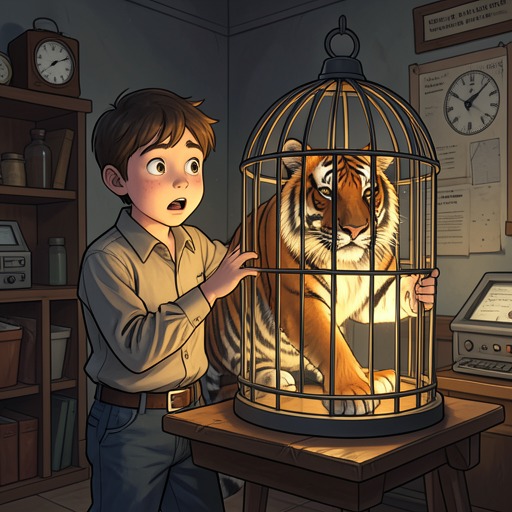
Beauchamp tells Rob that he owns a wild animal on his property and has large plans for it. When he drives Rob to the cage, he presents the tiger as his possession and explains that he acquired it from a man who owed him money, who paid him with the animal and its cage. Beauchamp’s account makes the tiger part of a transaction: the animal has come into his hands as payment, rather than through any relationship of care or mutual recognition.
His plans remain undecided. He considers placing the tiger in front of the Kentucky Star to attract more motel business, treating the animal as an advertisement, but also says he might kill it and make a coat from its skin. These alternatives put spectacle and destruction side by side. In either case, Beauchamp speaks of the tiger in terms of what it might do for him, while the animal stands and looks at him and he turns his gaze away.
Hiring Rob and the Cage Keys
Beauchamp offers Rob two dollars each time he feeds the tiger, which needs meat twice a day. He frames the job as daily maintenance and brings Rob to the cage to show him the work. Rob asks how the meat is to be put inside; Beauchamp answers by producing a set of keys and warning him about the large keys, which unlock the door and could let the tiger out. He insists that Rob understands the danger and says he trusts him not to open the door.
The keys make the work a controlled risk: Beauchamp delegates feeding but keeps the distinction between the access needed for the task and the locks that contain the animal in the foreground. His warning is also revealing. Although he speaks as the owner who sets the rules, he relies on a boy to perform the repeated labor of caring for a powerful animal, and his arrangement depends on Rob respecting a boundary Beauchamp himself is unwilling to cross.
Fear, Control, and Consequences
After Beauchamp leaves in his jeep, Sistine tells Rob that Beauchamp is afraid of the tiger and that this is why he makes Rob feed it. Rob nods, recognizing her observation as a truth he had already sensed without fully knowing it. The moment recasts Beauchamp’s boastful ownership: he may claim the tiger, choose its possible uses, and hand out the keys, but he keeps his distance from the daily encounter with the animal.
That division between authority and exposure defines Beauchamp’s role in the tiger’s captivity. He makes decisions about the tiger’s future and profits from Rob’s labor, while Rob and Sistine confront the animal more directly. Beauchamp’s fear does not prevent him from maintaining control over the tiger’s confinement, but it complicates the performance of mastery on which his plans depend. The contrast helps shift attention from what Beauchamp says he owns to the costs of keeping a living animal as property.